
Roof Leak Repairs in Perth
Water coming through the ceiling is stressful, and it’s worse when nobody calls you back. We trace Perth roof leaks to where the water actually gets in, fix the cause, and hose-test the repair before we leave. You get photos of what we found and a written price before any work starts.
Leaks Traced to Source
Repair Soak-Tested
Storm Make-Safes
Photo Reports
What Should I Do If My Roof Is Leaking Right Now?
Catch the water, protect what’s underneath and make it safe. Put a bucket or towels under the drip, move furniture and electronics away, and turn off power to any light or fan the water is near. If the ceiling is bulging, keep people out of the room. Take photos for insurance, then call a roofer to make the roof safe.
Call → we’ll make it safe first
Leaking Right Now? Do This First
Safety comes before the roof. For storm damage that’s dangerous right now (a roof torn off, a tree through it), call the SES on 132 500.
Then do this:
What Causes Roof Leaks in Perth?
Most Perth roof leaks come from a handful of weak points. Long summers of 35°C+ heat open the gaps, and the winter fronts find them. Perth gets about 78% of its yearly rain between May and September (Bureau of Meteorology averages), so a roof can sit with a hidden fault for months and then leak in the first heavy front. Here’s where we find them, most common first.
01. Valley irons
The valley is the metal channel where two roof slopes meet. It carries more water than any other part of a tile roof, so it leaks first. Old galvanised valleys rust through, leaves and tile grit pile up and push water sideways, and tiles cut too short let water run over the edge. Telltale signs: orange rust streaks, holes you can see from the roof space, and a ceiling stain near an internal corner.
02. Ridge and hip capping
The curved tiles along the top and hips of a tile roof sit on a bed of mortar, finished with pointing. Perth heat cracks old cement pointing, the bedding loosens, and wind-driven rain gets under the caps. Crumbling mortar on the ridge, or a cap that moves when pushed, is a likely leak point. See ridge capping and repointing.
03. Cracked, slipped or porous tiles
One cracked tile can leak, especially over a ceiling with no sarking under it. Tiles crack from people walking on them (antenna, solar and aircon installers are common culprits), from hail, and from age. Old concrete tiles can also turn porous once the surface coating wears away. See tile roof repairs.
04. Flashings
Flashings are the metal or lead strips that seal the roof where it meets a wall, chimney, skylight or another roof level. They leak when the lead splits, sealant shrinks away in the heat, or the flashing was never turned into the brickwork properly. A leak where an upper storey meets a lower ceiling is very often a flashing problem.
05. Loose, rusted or overdriven screws
Colorbond and Zincalume roofs are held down by screws with rubber washers. Washers perish in UV, screws work loose as the steel expands and contracts in summer heat, and overtightened screws crush the washer. You’ll often see a rust halo around the screw head. See Colorbond and metal roof repairs.
06. Box gutters and blocked gutters
A box gutter runs inside the roof, often between two roof sections or behind a parapet. When it overflows, the water goes straight into the house. Undersized box gutters, missing overflows and blocked outlets are a common Perth leak, especially on older townhouses and character homes. See gutters and downpipes.
07. Solar panels, evap units, skylights and aerials
Anything that goes through or sits on the roof is a potential leak. We regularly find tiles cracked under solar rails, evap cooler bases with failed flashing, skylights sealed only with silicone, and aerial brackets screwed into a valley. If your leak started after an install, the install is the first suspect.
What Roof Leak Damage Looks Like
These are the leak points we find most often on Perth roofs. If you can see any of them from the ground or in the roof space, get it checked before the next front.
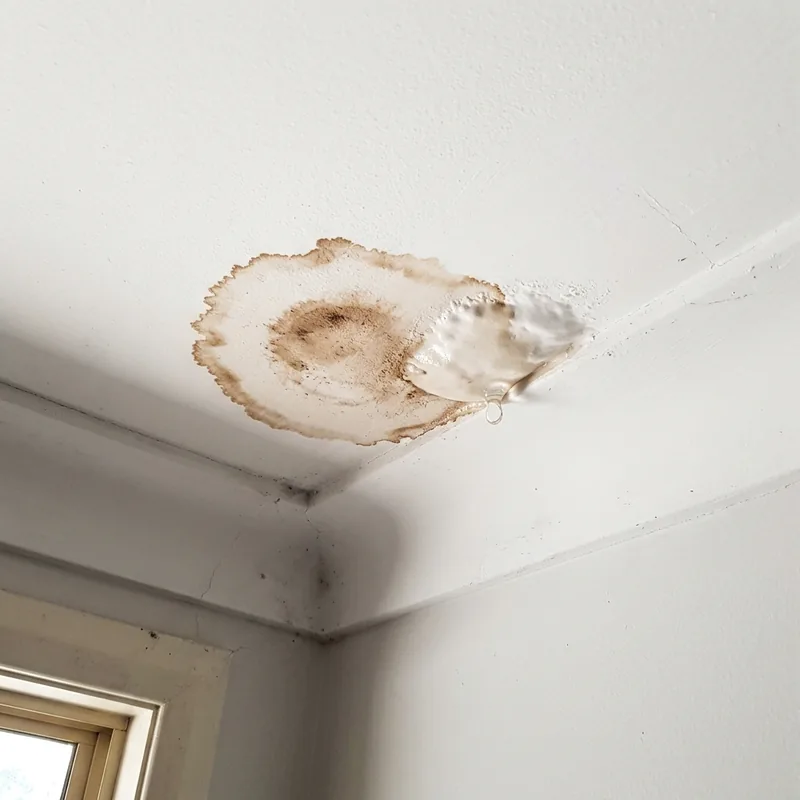 Ceiling stain → trace the leak to its source
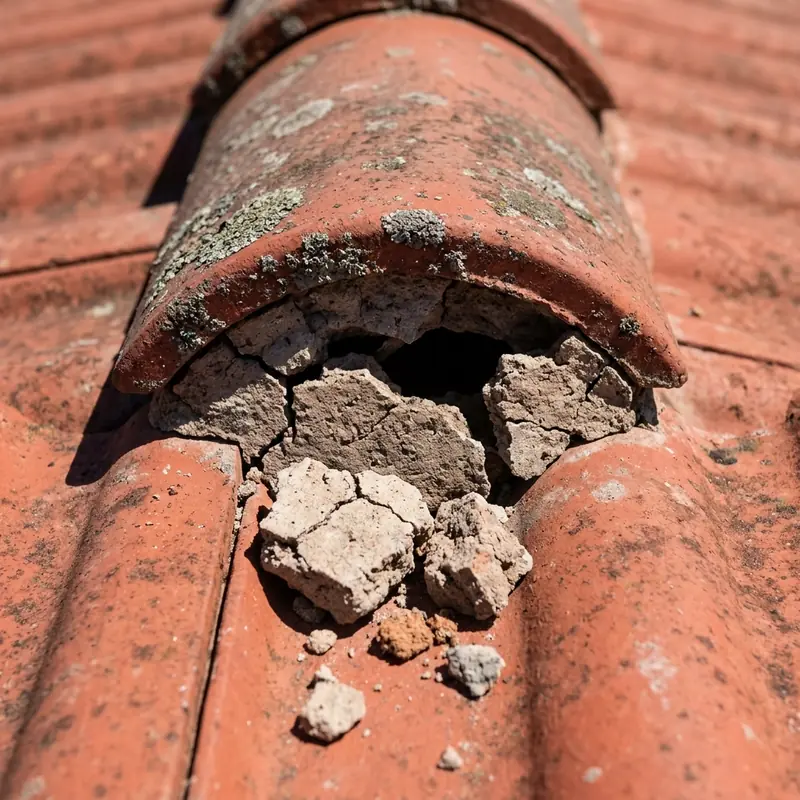 Crumbling ridge mortar → rebed and repoint
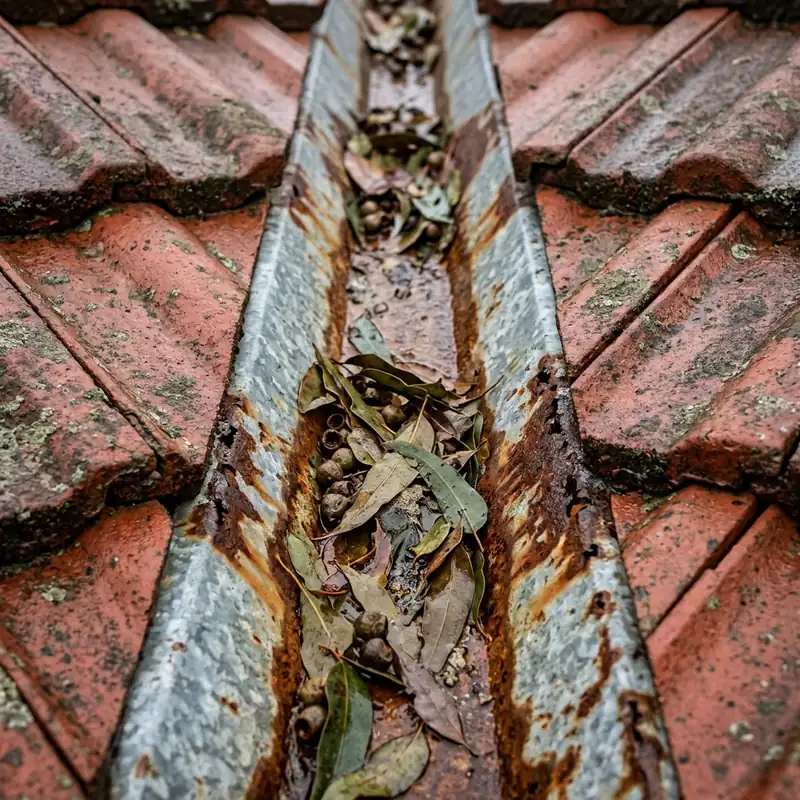 Rusted valley iron → replace the valley
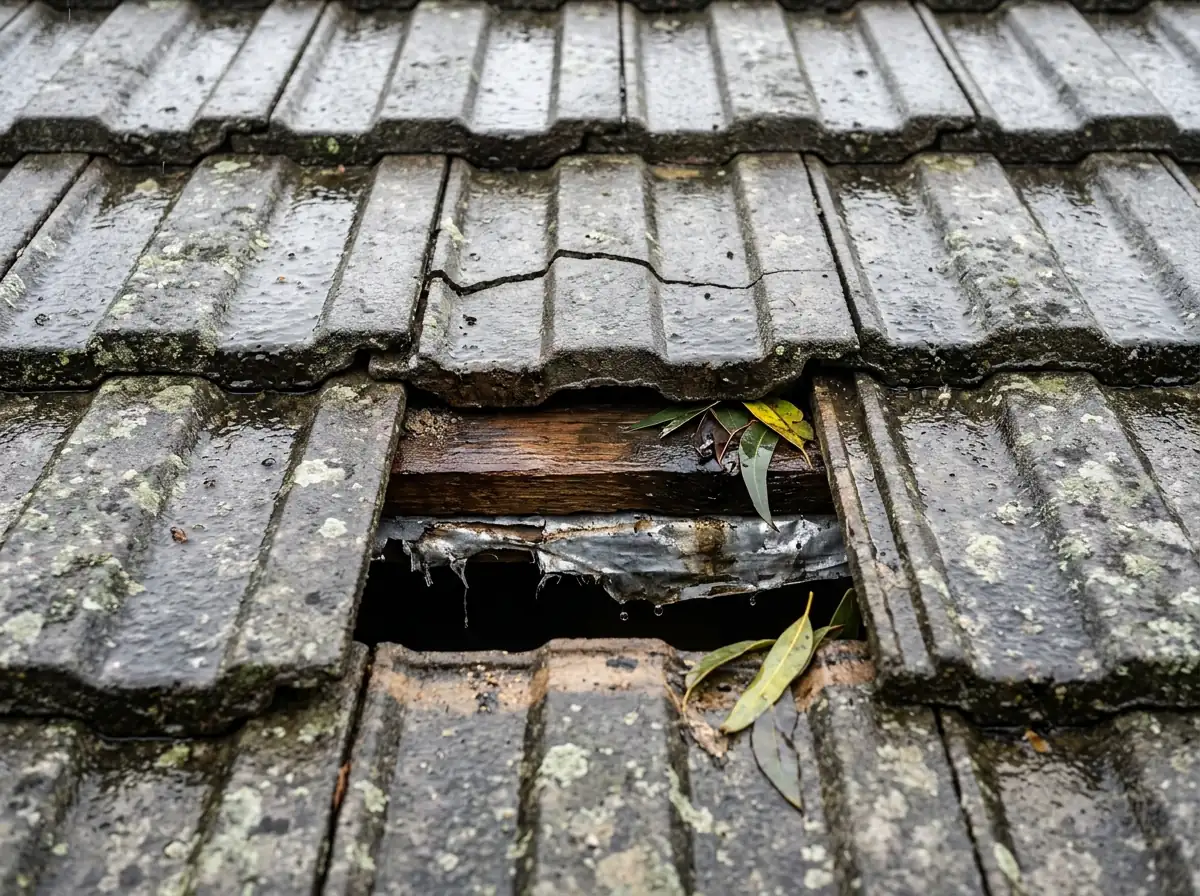 Cracked or slipped tile → replace and match
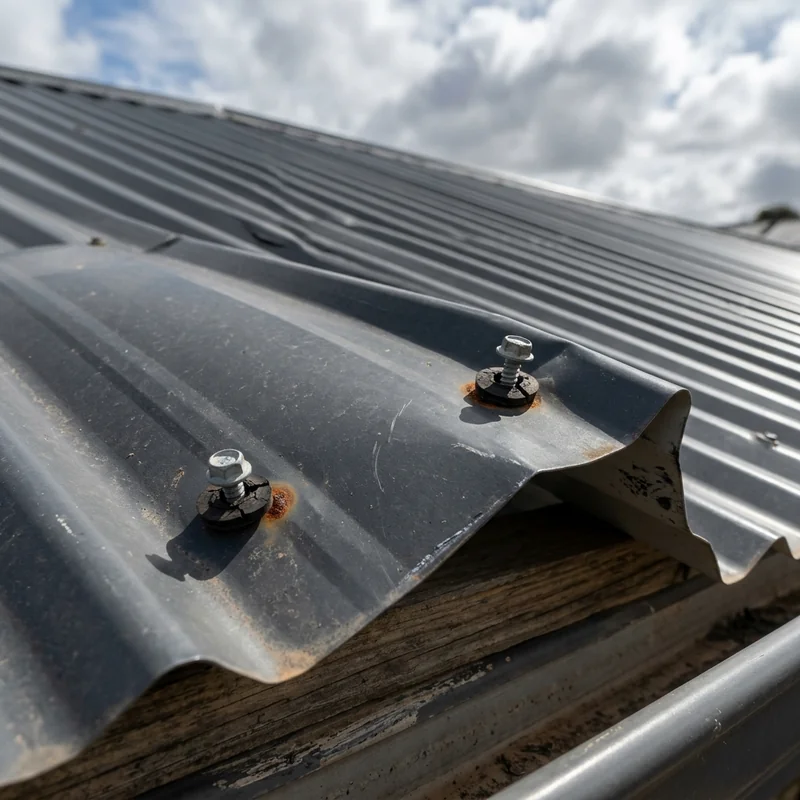 Lifted sheet, loose screws → refix and reseal
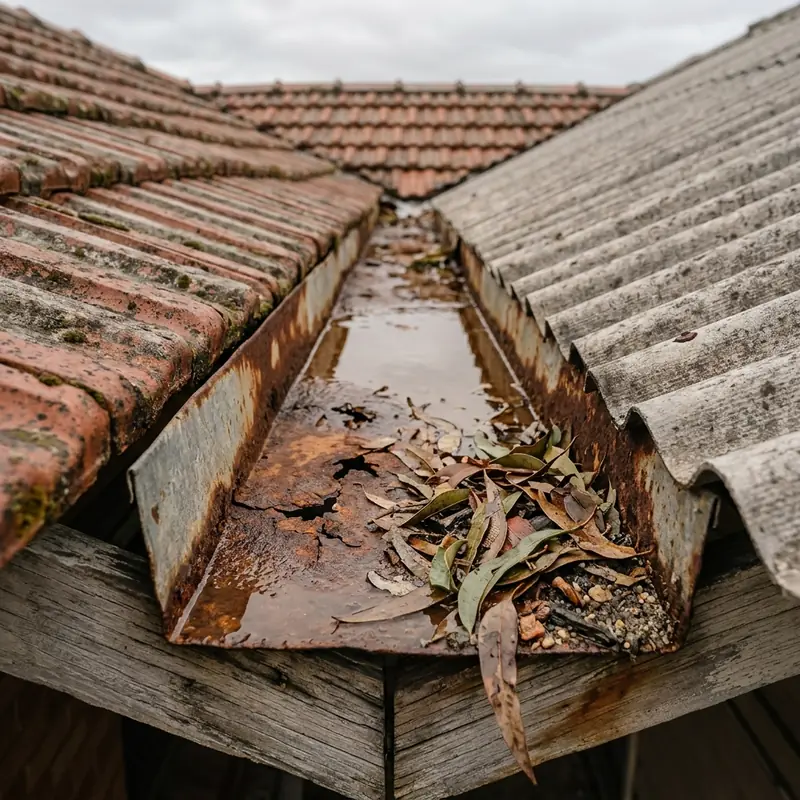 Rusted box gutter → clear, reseal or replace
Why Can’t I Find Where My Roof Is Leaking?
Because water rarely drips where it gets in. It runs down sarking, along battens and rafters, and across the top of the ceiling before it finds a gap. A stain over the bedroom can start two metres up the roof at a valley or ridge. Some leaks only appear with wind from one direction, which is why they seem to come and go.
This is the most common complaint we hear: “three roofers have looked and it still leaks.” Usually someone has patched the spot above the stain instead of following the water. Perth’s coastal suburbs add another twist: the afternoon Fremantle Doctor and winter fronts drive rain sideways, so a roof can be dry in straight-down rain and leak in a south-westerly.
How Do Roofers Find a Roof Leak?
A good roofer works from the inside out, then proves it with water. We check the roof space for stains, wet insulation and daylight, trace the path uphill, inspect the roof above that path, then run a hose over one section at a time (starting low) until the leak shows inside. After the repair, we run the same test again.
1. Roof space check
Water marks on timber and sarking, damp insulation, daylight through gaps, rust drips.
2. Roof inspection
Valleys, ridges, flashings, penetrations, gutters and screws above the water path, all photographed.
3. Hose test
Water applied in sections from the bottom up while someone watches inside, so the leak is confirmed, not guessed.
4. Repair and re-test
Fix the cause, then soak-test the repair before we pack up.
If a roofer has “fixed” your leak without ever going into the roof space or running water over the roof, it’s a guess.
Is It a Roof Leak or Condensation?
A roof leak shows up during or soon after rain, in one area, and often gets worse with wind from one direction. Condensation shows up on cold mornings without rain, as drips spread across a metal roof’s underside, a damp bathroom ceiling or mould on cold walls. Metal roofs with no anticon or sarking under them are the most common condensation problem in Perth.
|
What you notice |
Likely a roof leak |
Likely condensation |
|---|---|---|
|
When it happens |
During or after rain |
Cold, still mornings, often with no rain |
|
Where |
One spot or a line |
Spread out, often bathrooms or under bare metal roofs |
|
Wind direction matters |
Often |
No |
|
What helps |
Fixing the roof |
Insulation blanket (anticon), ventilation, exhaust fans ducted outside |
Bathroom ceilings are the trickiest. Bubbling or peeling paint over the whole ceiling usually points to steam and a poorly vented exhaust fan. A brown ring in one spot after rain points to the roof. We’ll tell you which it is before you spend money on either.
How Much Does It Cost to Fix a Roof Leak in Perth?
Most single roof leaks in Perth cost a few hundred dollars to fix. Independent Perth cost guides put minor leak repairs at about $260 to $850 (November 2026). Leaks from rusted valleys, failed ridge capping or box gutters cost more, often $1,000 or more, because more material is replaced (one Perth homeowner was quoted $4,000 for a leak along a steep ridge). A written quote after inspection is the only real answer.
|
Leak repair |
Estimated Perth cost |
What drives the price |
|---|---|---|
|
Minor leak repair (a few tiles, a flashing, screws) |
$260–$850 |
Access, height, what has failed |
|
Leak investigation and inspection report |
$250–$550 |
Roof size, roof space access |
|
Broken tile replacement |
$45–$120 per tile |
Tile matching, number of tiles |
|
Flashing or metal sheet repair |
$450–$2,200 |
Lead vs steel, height, wall type |
|
Valley iron replacement |
$85–$180 per metre |
Valley length, tiles lifted and rebedded |
|
Full ridge rebed and repoint |
$1,500–$4,500 |
Metres of ridge and hip, condition of old bedding |
|
Box gutter repair or reline |
$380–$950 |
Length, outlets, overflows, access |
Estimated Perth costs, November 2026, from independent Perth cost guides. Indicative only, not a quote: your price depends on your roof. WA Consumer Protection advises getting more than one written quote, and prices must include GST.
What makes a leak expensive: waiting. A leak left through one winter often adds new insulation, ceiling plasterboard and painting to the bill, and sometimes mould treatment.
Be wary of quotes that are too cheap. A price that couldn’t cover materials usually means a patch, not a repair.
How Long Can You Leave a Leaking Roof?
Days, not weeks. Even a slow drip soaks insulation, stains and softens plasterboard, and rots timber over time. Mould can start growing on damp materials within 24 to 48 hours. A sagging ceiling can collapse. In a Perth winter, each new front adds more water, so a small leak in June can be ceiling damage by August.
Perth Facebook groups regularly carry posts like “walked into the spare room and the ceiling had collapsed.” That’s almost always a leak that dripped quietly into the ceiling space for weeks.
Can a Roof Leak Be Repaired From the Inside?
Not properly. You can catch water and slow damage from inside, but the leak has to be fixed where water gets in, on the outside. Sealant smeared on the underside of tiles or sheets traps water and hides the problem. Inside work is for diagnosis: finding the water path, checking timber and replacing wet insulation.
Does roof repair tape or a Bunnings fix work?
As a stop-gap, sometimes. Flashing tape or a tube of roof sealant can hold a small metal-roof leak until a proper repair, if the surface is clean and dry. On tile roofs, it rarely works for long: tiles move, mortar cracks, and the water finds the next gap. Treat any DIY patch as temporary and get the cause fixed before the next front.
Is a Roof Leak Covered by Insurance in Australia?
Often, if a storm caused it. Most home insurance policies cover sudden storm damage, like tiles broken by hail or sheets lifted by wind, plus the water damage that follows. Most policies exclude wear and tear: perished mortar, rusted valleys, old flashings. Insurers check for maintenance, so a dated roofer’s report with photos matters.
What we give you for a claim:
If your claim is refused and you disagree, your insurer’s internal complaints process comes first, then the Australian Financial Complaints Authority (AFCA).
Should a New Roof Leak After 5 Years?
No. A roof that’s only a few years old shouldn’t leak. When it does, it’s usually workmanship: flashings not turned into the wall, screws in the wrong place, valleys cut short, or penetrations added later. Check your workmanship warranty and contact the original installer in writing first. If they won’t help, an independent report documents the fault.
Who Is the Best Person to Fix a Leaking Roof?
A roofer for tile roofs and a roof plumber for metal roofs, gutters and flashings, ideally one business that does both and will trace the leak rather than patch it. Look for someone who goes into the roof space, tests with water, shows you photos, puts the price in writing and offers a workmanship warranty.
Questions to ask any roofer before you book:
Landlords & Property Managers: Rental Leaks Fixed Without the Chasing
01. Urgent repairs first
A serious roof leak counts as an urgent repair for a WA rental. Tenanted properties go to the front of the queue.
02. Tenant access handled
We arrange access directly with the tenant and keep the agent in the loop, so you don’t have to play phone tag.
03. Photo reports for the owner
Before and after photos, the cause and the fix, formatted for the owner and the agent’s file.
04. Before-winter checks
An autumn roof check across your portfolio catches cracked tiles and blocked valleys before the May fronts.
05. Insurance-ready paperwork
Dated reports that separate storm damage from wear and tear, plus itemised invoices for your accountant.
Our Roof Leak Repair Process
1. Phone triage
We ask what you’re seeing and when. If it’s urgent, we prioritise you.
2. Inspection
Roof space and roof, with photos of every issue.
3. Written quote
Cause, fix, price and warranty, in plain English.
4. Make-safe if needed
Tarps or a temporary seal if it’s still raining.
5. Repair and soak test
Fix the cause, then prove it with water.
6. Follow-up
We check in after the next decent rain.
How we work: Fix My Roof Perth connects your booking with a licensed, insured local roofer who carries out the work. Every leak job comes with dated photos of what was found and fixed, a written scope and price before work starts, and a hose test before anyone packs up.
Roof Leak FAQs
Quick answers to the leak questions Perth homeowners ask us most. If yours isn’t here, call and ask.
Call (08) 5550 0123
Related: Emergency and storm repairs · Tile roof repairs · Colorbond repairs · Roof inspections
Get Your Leak Fixed Properly
Call (08) 5550 0123 or send a photo of the stain and the roof. We’ll tell you if it’s urgent, make it safe if needed, and fix the cause, not the drip.
Fill out the form and we’ll call you back.

Roof repairs, restorations and roof plumbing across Perth, from Yanchep to Mandurah and the Hills.
Call (08) 5550 0123
Email info@fixmyroofperth.com.au
Services
Areas We Serve
All of Perth, north and south of the river
Copyright © 2026 Fix My Roof Perth. Fix My Roof Perth connects Perth homeowners with a licensed, insured local roofer.
Fix My Roof Perth is a referral service. We connect Perth homeowners with independent, licensed local roofing contractors, who are responsible for the work they carry out, including their licensing, insurance and workmanship warranty. Always check a contractor’s licence before work begins.